
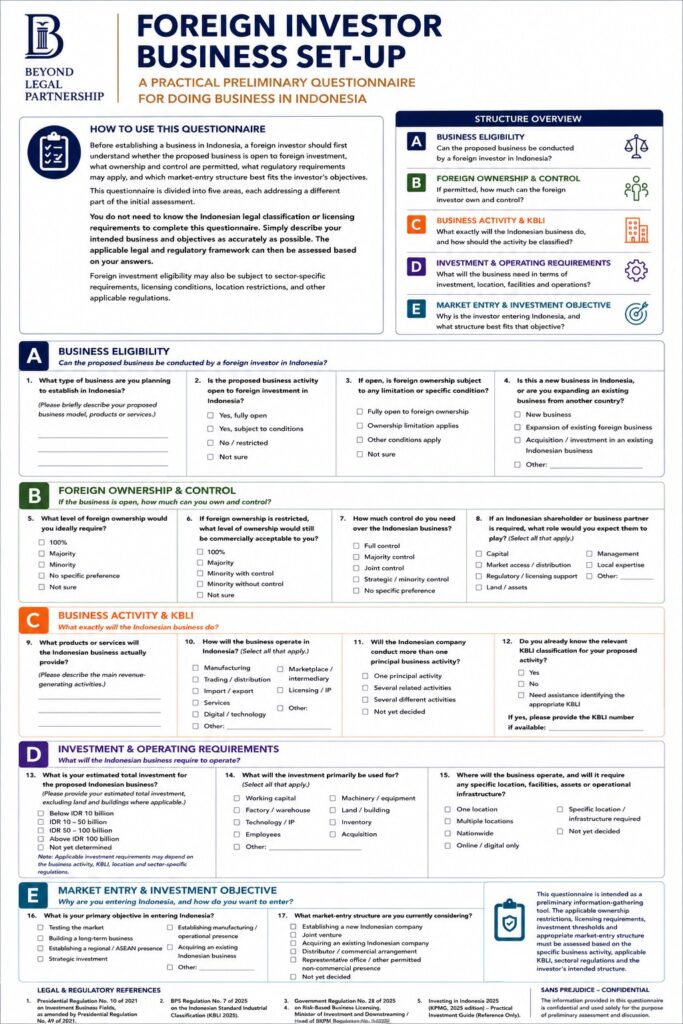
This text is designed to be read together with the accompanying infographic. The structure and sequence below follow the artwork so that a reader can either scan the visual questionnaire or read the same framework in full sentences.
The purpose is not to provide a definitive legal opinion at this stage. It is to collect the key facts needed to assess foreign-investment eligibility, ownership and control, business classification, investment and operating requirements, and the most appropriate market-entry structure.
You do not need to know the Indonesian legal classification or licensing requirements to complete the questionnaire. Simply describe the intended business and objectives as accurately as possible. The applicable legal and regulatory framework can then be assessed based on the answers.
(Please briefly describe your proposed business model, products or services.)
Why this matters: The starting point is the actual business proposed. The business description is used to identify the relevant activity and assess whether foreign investment is permitted.
☐ Yes, fully open
☐ Yes, subject to conditions
☐ No / restricted
☐ Not sure
Why this matters: This is the first eligibility assessment. The answer must ultimately be checked against the applicable investment framework and sector-specific rules.
☐ Fully open to foreign ownership
☐ Ownership limitation applies
☐ Other conditions apply
☐ Not sure
Why this matters: Foreign-investment eligibility does not necessarily mean unrestricted foreign ownership. Ownership caps or other conditions may apply depending on the business activity and applicable regulations.
☐ New business
☐ Expansion of existing foreign business
☐ Acquisition / investment in an existing Indonesian business
☐ Other
Why this matters: The intended route into Indonesia may affect the legal structure and the issues that need to be assessed.
☐ 100%
☐ Majority
☐ Minority
☐ No specific preference
☐ Not sure
Why this matters: The investor’s commercial preference should be identified separately from what Indonesian law permits.
☐ 100%
☐ Majority
☐ Minority with control
☐ Minority without control
☐ Not sure
Why this matters: This identifies the investor’s fallback position if full foreign ownership is not legally available.
☐ Full control
☐ Majority control
☐ Joint control
☐ Strategic / minority control
☐ No specific preference
Why this matters: Ownership percentage and practical control are different issues. The required level of control should therefore be identified explicitly.
☐ Capital
☐ Management
☐ Market access / distribution
☐ Regulatory / licensing support
☐ Land / assets
☐ Local expertise
☐ Other
Why this matters: A local participant may have a commercial or operational role beyond simply holding shares. The intended role should be understood before the structure is designed.
(Please describe the main revenue-generating activities.)
Why this matters: The substance of the business is critical to determining the appropriate KBLI and the regulatory framework that follows.
☐ Manufacturing
☐ Trading / distribution
☐ Import / export
☐ Services
☐ Digital / technology
☐ Marketplace / intermediary
☐ Licensing / IP
☐ Other
Why this matters: Different operating models may correspond to different classifications, licensing requirements and sectoral rules.
☐ One principal activity
☐ Several related activities
☐ Several different activities
☐ Not yet decided
Why this matters: Multiple activities may require multiple KBLI classifications and may affect the investment and licensing analysis.
☐ Yes
☐ No
☐ Need assistance identifying the appropriate KBLI
Why this matters: The investor does not need to determine the KBLI independently. If the classification is uncertain, the business description can be assessed against KBLI 2025.
☐ Below IDR 10 billion
☐ IDR 10–50 billion
☐ IDR 50–100 billion
☐ Above IDR 100 billion
☐ Not yet determined
Why this matters: This captures the investor’s estimated investment size. It should not be treated by itself as a statement of the legally required capital or investment threshold, which depends on the applicable rules.
☐ Working capital
☐ Machinery / equipment
☐ Factory
☐ Warehouse
☐ Office
☐ Inventory
☐ Land / building
☐ Technology / IP
☐ Acquisition
☐ Employees
☐ Other
Why this matters: The use of funds helps identify the practical operating model and potential asset, licensing, location and investment issues.
☐ One specific location
☐ Multiple locations
☐ Nationwide
☐ Online / digital only
☐ Office / factory / warehouse
☐ Retail outlet
☐ Land / building
☐ Import / export
☐ Foreign personnel
☐ Construction / physical project
☐ Other / None
Why this matters: Location and operational infrastructure can affect licensing, land, facilities, staffing and sector-specific requirements.
☐ Testing the market
☐ Building a long-term business
☐ Expanding an existing regional business
☐ Manufacturing
☐ Distribution
☐ Investment
☐ Acquisition
☐ Establishing a regional hub
☐ Other
Why this matters: The same business may justify different entry structures depending on whether the investor is testing the market, building a permanent operation, acquiring a business or establishing a regional presence.
☐ Establish a new PMA company
☐ Joint venture
☐ Acquire an existing Indonesian company
☐ Acquire a business / assets
☐ Distributor / agent
☐ Representative office
☐ Contractual arrangement
☐ Not yet decided
Why this matters: The investor’s preferred entry route is a starting point, not a predetermined legal conclusion. The appropriate structure should be assessed against the business activity, foreign-ownership rules, operational needs and commercial objectives.
What are your three most important priorities? (Please select up to three.)
☐ 100% foreign ownership
☐ Maximum control
☐ Fast market entry
☐ Minimum initial investment
☐ Regulatory certainty
☐ Long-term scalability
☐ Access to Indonesian customers
☐ Manufacturing capability
☐ Asset ownership
☐ Foreign management
☐ Ability to raise additional investment
☐ Exit flexibility
☐ Other
What are you actually doing?
Is the activity open to foreign investment?
How much can you own?
How much control can you exercise?
What investment, licensing and sectoral requirements apply?
What is the most appropriate market-entry structure?
BEYOND RECOMMENDATION: The answers should ultimately be translated into a practical recommendation on the appropriate Indonesian market-entry structure, subject to detailed legal and regulatory assessment.
| A | Business Eligibility | Can the proposed business be conducted by a foreign investor in Indonesia? |
| B | Foreign Ownership & Control | If permitted, how much can the foreign investor own and control? |
| C | Business Activity & KBLI | What exactly will the Indonesian business do, and how should the activity be classified? |
| D | Investment & Operating Requirements | What will the business need in terms of investment, location, facilities and operations? |
| E | Market Entry & Investment Objective | Why is the investor entering Indonesia, and what structure best fits that objective? |
1. Presidential Regulation No. 10 of 2021 concerning Investment Business Fields, as amended by Presidential Regulation No. 49 of 2021.
2. BPS Regulation No. 7 of 2025 concerning the Indonesian Standard Industrial Classification (KBLI 2025).
3. Government Regulation No. 28 of 2025 concerning Risk-Based Business Licensing.
4. Minister of Investment and Hilirisasi / Head of BKPM Regulation No. 5 of 2025 concerning Risk-Based Business Licensing and Investment Facilities through the OSS System.
5. Investing in Indonesia 2025 (KPMG, 2025 edition) — practical reference.
6. Hukumonline materials concerning foreign investment and restricted business fields — secondary reference.
Important: This questionnaire is a preliminary information-gathering tool. The applicable ownership restrictions, licensing requirements, investment thresholds and appropriate market-entry structure must be assessed based on the specific business activity, applicable KBLI, sectoral regulations and the investor’s intended structure.